 9900550134
 info@dheehospitals.com


 Trauma and Orthopaedics
 Pediatrics
 Gastroenterology
 Obstetrics and Gynecology
 Neurosurgery and Neurology
 Family Medicine
 Cardiology
 General Medicine
 Oncology and Immunology
 Oncology
 Nephrology
 Nutrition and Dietetics
 Adult Intensive Care
Published on :Oct 26, 2026
A parent takes longer to button a shirt. Their handwriting becomes smaller, or one arm stops swinging naturally during walks. The changes seem minor, so the family puts them down to tiredness or ageing.
Parkinson’s disease often begins gradually, sometimes affecting one side more than the other. These changes do not confirm the condition, but persistent movement difficulties deserve assessment.
If you are searching for Parkinson’s disease treatment Bangalore, a neurological review can help distinguish Parkinson’s from other causes and identify appropriate support.
What Is Parkinson’s Disease?
Parkinson’s is a progressive neurological condition affecting movement and other body functions.
Many movement symptoms relate to the loss of brain cells producing dopamine, a chemical messenger involved in smooth, coordinated movement.
The condition affects people differently. Symptoms, progression and treatment needs vary, so one person’s experience cannot predict another’s.
It is more common with increasing age, but younger adults can also develop it.
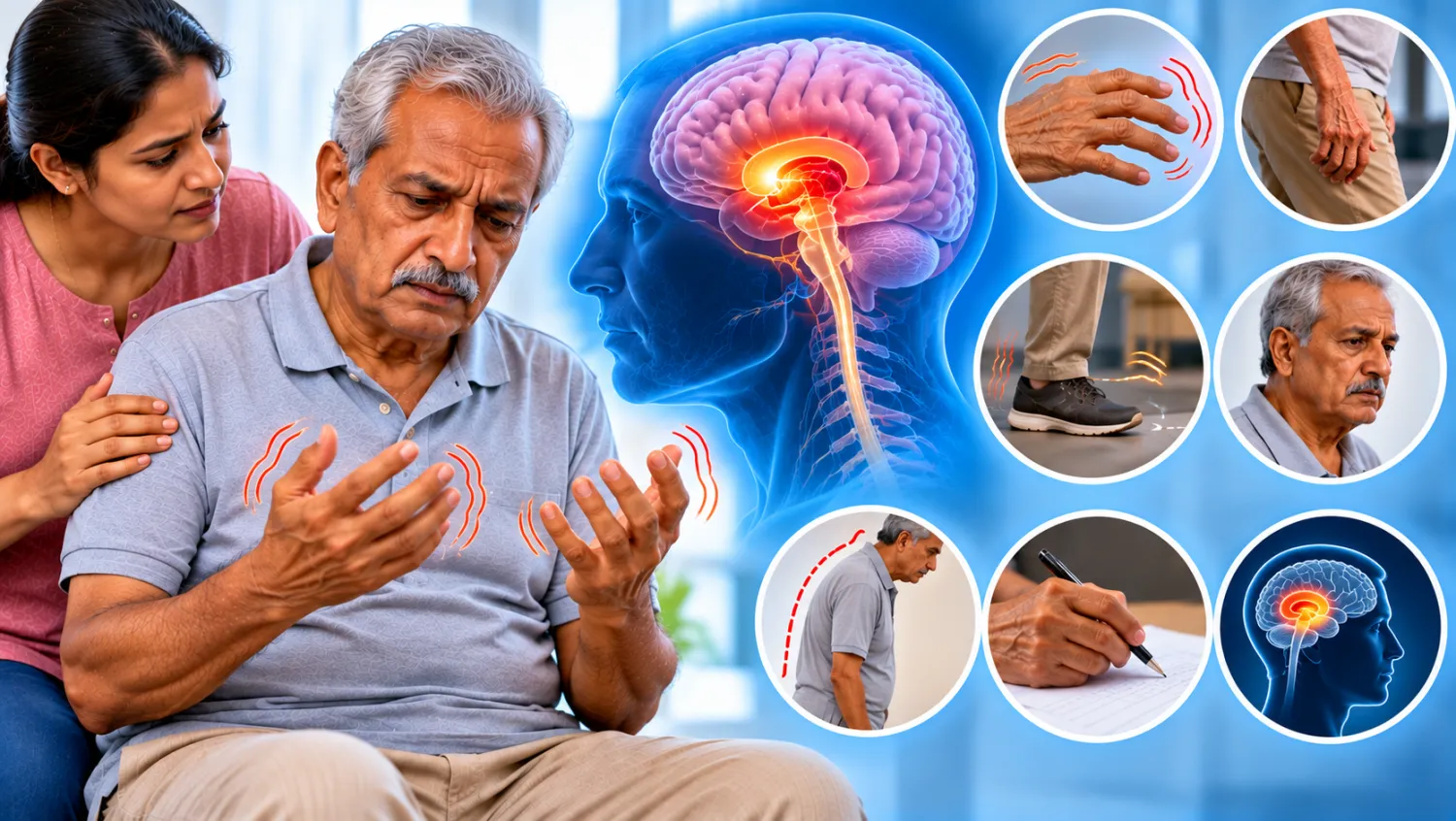
Early Signs of Parkinson’s Disease
Families may notice changes in everyday activities before the person recognises a pattern.
These can include:
- Smaller or increasingly cramped handwriting.
- Reduced arm swing on one side.
- Taking longer to dress or prepare food.
- A softer voice.
- Less facial expression.
- Difficulty turning in bed.
Each finding has other possible explanations. A combination of persistent changes is more informative than one isolated symptom.
Describe specific examples rather than telling someone they “look slower.”
Hand Tremor at Rest
A rhythmic shake may appear when the hand is relaxed, such as while resting in the lap. It may become less noticeable during purposeful movement.
However, not everyone with Parkinson’s develops tremor. Shaking can also result from essential tremor, medicines or other conditions.
Do not wait for a tremor before seeking advice about other movement changes.
Slow Body Movements
Doctors use the term bradykinesia for characteristic movement slowness. Repeated movements may become smaller or less effective.
Tasks such as fastening buttons, brushing teeth or typing may take longer. This is not necessarily a problem with motivation or effort.
For Parkinson’s disease treatment Bangalore patients should explain which activities have changed and how those changes affect independence.
Stiffness and Balance Problems
Muscle rigidity can make movement feel restricted. Someone may describe a stiff shoulder or reduced ease when turning.
Balance difficulties can develop, but frequent falls very early in the illness are less typical and need careful assessment for other explanations.
Painful joints, muscle conditions and neurological disorders can produce overlapping symptoms.
Avoid assuming that every stiff shoulder or stumble indicates Parkinson’s.
Parkinson’s Gait: What Can Families Notice?
Walking changes may include shorter steps, reduced arm swing and difficulty turning smoothly.
Some people later experience freezing, where their feet briefly seem stuck despite trying to move. Others develop a tendency to hurry with small steps.
These patterns vary and are not all early features.
Tell the clinician about falls, near-falls and situations that make walking harder. Do not deliberately create obstacles to test someone’s balance at home.
Can Non-Movement Symptoms Appear First?
Constipation, reduced sense of smell, sleep disturbances and mood changes can occur before obvious movement difficulties.
Some people act out dreams, moving or shouting during sleep. These observations are worth mentioning.
However, such symptoms are common in other conditions. They cannot diagnose Parkinson’s or reliably predict who will develop it.
Assessment considers the overall pattern.
How Is Parkinson’s Disease Diagnosis Made?
Diagnosis is mainly clinical: a specialist reviews the history and examines movement, muscle tone, walking and other neurological functions.
Bring a medication list because some medicines can cause Parkinson-like features. With permission, a short video may help show an intermittent symptom.
Are Brain Scans Always Needed?
No. MRI may help investigate alternative explanations, but a routine MRI does not confirm Parkinson’s.
Specialised dopamine-transporter imaging can help in selected uncertain cases. It cannot reliably distinguish Parkinson’s from every related disorder.
Early assessment may remain uncertain, making follow-up important.
What Does Treatment Involve?
For Parkinson’s disease treatment Bangalore, care should reflect symptoms, daily priorities and potential medicine side effects.
Medicines
Levodopa and other medicines can improve movement symptoms. The choice and timing depend on individual needs.
Treatment does not currently cure the disease or restore lost brain cells. Report dizziness, hallucinations, excessive sleepiness or new compulsive behaviours.
Never stop Parkinson’s medicines abruptly without medical advice.
Rehabilitation and Daily Support
Physiotherapy supports walking, strength and balance. Occupational therapy helps with dressing, work and household tasks.
Speech and language therapy can address voice or swallowing difficulties. Suitable exercise and nutritional support are also valuable.
Movement disorder treatment should include these practical needs alongside medication.
Are Procedures Appropriate for Everyone?
No. Deep brain stimulation may help selected patients whose symptoms are not adequately controlled with medicines.
It requires specialist assessment and does not treat every symptom or cure Parkinson’s.
How Can Families Help?
Ask which activities are becoming difficult and offer support without taking over unnecessarily.
Record changes, allow extra time and include the person in decisions. A quieter voice or reduced facial expression does not mean they are uninterested.
When Is Emergency Assessment Needed?
Parkinson’s usually develops gradually. Sudden facial drooping, arm weakness or speech disturbance requires emergency assessment for possible stroke.
Abrupt severe deterioration should not automatically be attributed to the existing condition.
Conclusion
Subtle movement changes are worth discussing when they persist or affect daily life. Assessment can clarify the cause and guide useful treatment.
For Parkinson’s disease treatment Bangalore, book a neurological consultation at DHEE Hospitals. If you need a neurologist near Kanakapura Road, its neurosciences team can assess symptoms and recommend an individual care plan.
Frequently Asked Questions
Does everyone develop shaking?
No. Some people have little or no tremor.
Can symptoms begin on one side?
Yes. Uneven onset is common.
Does small handwriting confirm Parkinson’s?
No. It is one possible clue among others.
Can younger adults develop it?
Yes, although it is more common with age.
Can a normal MRI rule it out?
No. Diagnosis mainly depends on clinical assessment.
Does every patient need medicines immediately?
No. Treatment depends on symptoms and individual needs.
Can exercise replace prescribed medicines?
No. It complements an individual treatment plan.
Is Parkinson’s curable?
Not currently, but treatment can improve symptoms and daily function.





 WhatsApp Us