 9900550134
 info@dheehospitals.com


 Trauma and Orthopaedics
 Pediatrics
 Gastroenterology
 Obstetrics and Gynecology
 Neurosurgery and Neurology
 Family Medicine
 Cardiology
 General Medicine
 Oncology and Immunology
 Oncology
 Nephrology
 Nutrition and Dietetics
 Adult Intensive Care
Published on :Oct 26, 2026
You turn suddenly during a game and feel pain inside your knee. You can still walk, but swelling develops later. Over the next few days, the joint catches when you stand up or feels difficult to straighten.
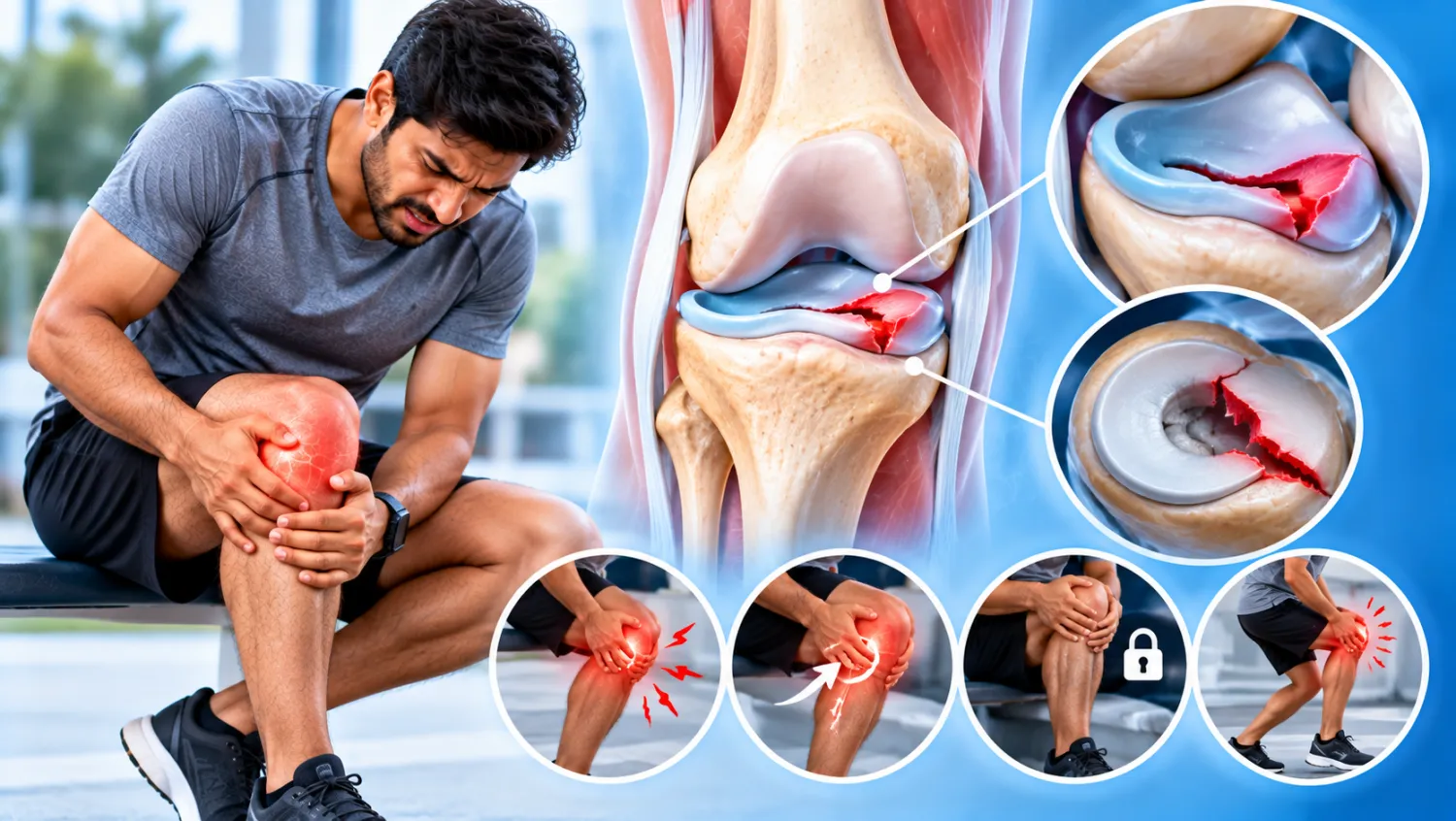
A meniscus tear is one possible explanation. Painless clicking is often harmless, but clicking with pain, swelling or restricted movement deserves assessment. A knee that remains physically locked needs urgent review.
If you are searching for meniscus tear treatment Bangalore, understanding the symptoms helps you seek appropriate care without assuming surgery is inevitable.
What Is the Meniscus?
Each knee has two crescent-shaped pads of cartilage between the thigh bone and shin bone. These are the medial and lateral menisci.
They help distribute load, absorb shock and support joint stability. A tear can interfere with these functions, although its impact depends on its size, location and pattern.
Some tears develop after an injury. Others occur gradually as tissue becomes more vulnerable with age.
Meniscus Tear Symptoms to Notice
Possible symptoms include:
- Pain along the inner or outer knee joint line.
- Swelling and stiffness.
- Catching during movement.
- Difficulty fully bending or straightening.
- A feeling that the knee may give way.
You may feel a pop during an injury, but not everyone does. Being able to walk afterwards does not exclude a tear.
Symptoms can also come from ligament injuries, arthritis or other knee conditions.
Knee Locking and Clicking: What Is the Difference?
Clicking is a sound or sensation during movement. Without pain or functional change, it does not necessarily indicate damaged cartilage.
Catching is a brief interruption in movement. True locking means the knee becomes stuck and cannot fully straighten because something may be mechanically blocking it.
When Does Locking Need Urgent Assessment?
A persistently locked knee, particularly after a twisting injury, needs urgent orthopaedic review. A displaced tear can sometimes block movement and require earlier treatment.
Do not force the joint straight or repeatedly twist it to release the blockage.
For meniscus tear treatment Bangalore patients should explain whether the knee briefly catches or remains unable to straighten.
Knee Pain After Twisting: How Can a Tear Happen?
Turning while your foot remains planted can place stress on the meniscus. Squatting, pivoting or an awkward landing can also cause injury.
A sports knee injury may involve both the meniscus and a ligament, such as the anterior cruciate ligament.
In older adults, a smaller movement may trigger symptoms because the tissue has already undergone degenerative change. The treatment approach can differ from that for a fresh traumatic tear.
What Should You Do Initially?
Reduce activities that worsen pain, particularly pivoting, deep squatting and running. Short periods of ice wrapped in a towel may help swelling.
Use support or crutches if advised, and ask a clinician or pharmacist which pain relief is suitable.
Avoid prolonged complete rest unless instructed. Appropriate movement helps prevent stiffness, but exercises should not be forced through locking or severe pain.
Which Other Signs Need Immediate Care?
Seek urgent assessment if you cannot bear weight, the knee looks deformed, or swelling is severe after an injury.
A hot, red knee with fever or significant illness also needs urgent care because infection is a possible cause.
How Is a Tear Diagnosed?
The doctor asks how symptoms started and examines movement, tenderness, swelling and stability. Clinical tests help assess the meniscus and other structures.
MRI for Meniscus Tear
MRI provides detailed images of cartilage, ligaments and other soft tissues. It may help confirm an acute tear or guide treatment planning.
However, not every painful knee needs an immediate MRI. Meniscal changes can appear on scans in people without symptoms, particularly with age.
The findings must match the history and examination.
Why Might an X-Ray Be Recommended?
An X-ray does not show a meniscal tear directly, but it can identify fractures or arthritis that influence management.
For meniscus tear treatment Bangalore, the useful investigation is the one that answers the clinical question.
Meniscus Tear Physiotherapy: When Can It Help?
Many tears can initially be managed without an operation, especially when the knee is not locked.
Rehabilitation aims to restore movement, improve thigh and hip strength, and rebuild confidence with daily activities.
The programme should progress according to pain, swelling and function. Reduced symptoms do not necessarily mean the tear has disappeared; improved joint function can still make non-operative care successful.
Degenerative tears commonly improve with time and exercise-based treatment. Routine arthroscopy generally does not offer lasting additional benefit for most such cases.
When Is Arthroscopic Meniscus Surgery Considered?
Surgery may be discussed for a displaced tear restricting movement, a repairable traumatic injury or persistent symptoms despite appropriate rehabilitation.
Arthroscopy uses a camera and small instruments through incisions around the knee.
Repair or Partial Removal?
Repair stitches suitable tears together. Preserving functional meniscal tissue is important for long-term joint health.
If repair is unsuitable, the surgeon may trim an unstable fragment, removing as little tissue as practical.
Discuss healing potential, risks and rehabilitation before deciding.
How Long Does Recovery Take?
Recovery depends on the tear, associated injuries and treatment.
Repair usually requires longer protection and rehabilitation than partial trimming. Return to sport should depend on movement, strength, swelling and the treating team’s clearance—not a calendar date alone.
Attend follow-up if pain, locking or swelling persists.
Conclusion
Knee noises alone are not always concerning. Persistent pain, catching or a blocked joint warrants assessment so treatment matches the actual problem.
For meniscus tear treatment Bangalore, book an assessment at DHEE Hospitals. If you need an orthopaedic doctor Kanakapura Road, its sports injury team can discuss rehabilitation and surgical options when appropriate.
Frequently Asked Questions
Does every click mean a tear?
No. Painless clicking can occur in healthy knees.
Can I walk with a torn meniscus?
Sometimes. Walking ability does not exclude injury.
Does every tear require surgery?
No. Many improve with non-operative care.
Can a scan finding be incidental?
Yes, particularly with age-related changes.
Should I force a locked knee straight?
No. Seek urgent assessment.
Can physiotherapy help without healing the tear?
Yes. Better strength and movement can improve function.
Is repair always possible?
No. Suitability depends on tear pattern and tissue quality.
When can I resume sport?
After individual assessment and rehabilitation milestones are met.





 WhatsApp Us