 9900550134
 info@dheehospitals.com


 Trauma and Orthopaedics
 Pediatrics
 Gastroenterology
 Obstetrics and Gynecology
 Neurosurgery and Neurology
 Family Medicine
 Cardiology
 General Medicine
 Oncology and Immunology
 Oncology
 Nephrology
 Nutrition and Dietetics
 Adult Intensive Care
Published on :Oct 26, 2026
Meals should not regularly involve coughing, repeated attempts to swallow or the feeling that food will not go down. Yet some people adapt quietly, avoiding certain foods or taking smaller bites instead of seeking help.
Persistent or worsening swallowing difficulty needs medical assessment. The appropriate investigation depends on whether the problem involves the mouth and throat, the food pipe, or both.
If you are searching for difficulty swallowing treatment Bangalore, describing exactly what happens during meals helps the doctor choose the right assessment.
What Is Dysphagia?
Dysphagia means difficulty moving food, liquids or saliva from the mouth to the stomach.
Swallowing involves coordinated muscles and nerves. Problems can arise when this coordination is disrupted, the food pipe becomes narrowed, or its muscles do not move food normally.
It can affect any age group. Repeated difficulties should not be dismissed as a normal part of ageing.
Dysphagia Symptoms to Notice
Possible signs include:
- Coughing or choking while eating or drinking.
- Needing several attempts to swallow.
- A wet, gurgling voice after meals.
- Food coming back into the mouth or nose.
- Unintentional weight loss.
- Repeated chest infections.
A sensation of food stuck in throat may actually come from a problem lower in the oesophagus. Where you feel the obstruction does not always identify its location.
Is Pain the Same as Difficulty Swallowing?
No. Painful swallowing is called odynophagia. It can occur with inflammation, infection or other conditions, with or without a swallowing obstruction.
Both symptoms deserve assessment when persistent, significant or worsening.
Why Does the Pattern Matter?
Your doctor will ask whether the problem starts immediately or develops after you have swallowed.
Difficulty Starting a Swallow
Coughing as you swallow, nasal regurgitation or a wet voice may suggest a mouth or throat coordination problem.
Stroke, neurological conditions, previous surgery and head or neck disorders can contribute.
Difficulty Swallowing Solids
Trouble with solid food may suggest narrowing, such as a ring, scar-related stricture or another structural problem.
Difficulty with both solids and liquids can suggest a movement disorder, including achalasia. These patterns provide clues, not a diagnosis.
For difficulty swallowing treatment Bangalore patients should mention whether liquids, tablets and particular foods cause problems.
When Does It Become an Emergency?
Seek immediate hospital care if you cannot swallow your saliva, are drooling after food becomes lodged, or cannot breathe normally.
Do not force down more food or drink to push an obstruction through. A blocked food pipe may require urgent endoscopic removal.
Sudden swallowing problems with facial drooping, arm weakness or altered speech require emergency assessment for possible stroke.
Throat Cancer Warning Signs
Progressively worsening swallowing, unexplained weight loss, a neck lump, persistent hoarseness or bleeding needs prompt investigation.
These symptoms do not automatically mean cancer. However, repeated self-treatment for acidity should not delay assessment.
Gastroenterologist or ENT for Dysphagia: Who Should You See?
An ENT assessment is often useful when symptoms involve starting a swallow, voice changes, throat discomfort or a neck lump.
A gastroenterologist usually evaluates problems involving the oesophagus, particularly food sticking after swallowing.
Some patients need both specialties, alongside a speech and language therapist. A swallowing assessment also checks whether food or liquid is entering the airway, known as aspiration.
You do not need to identify the affected organ yourself before asking for help.
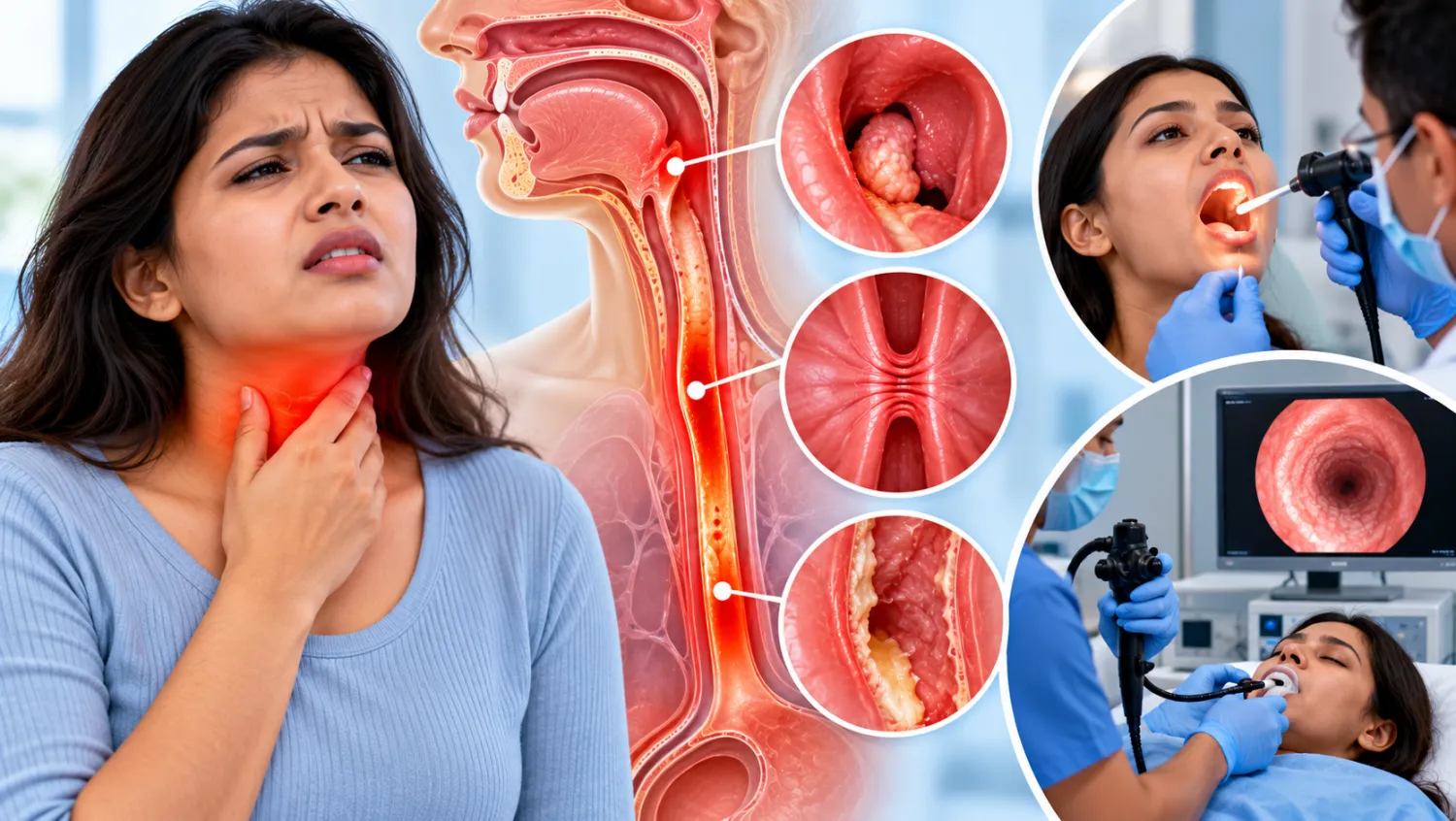
When Is Endoscopy for Swallowing Difficulty Needed?
Upper gastrointestinal endoscopy uses a flexible camera to examine the oesophagus, stomach and first part of the small intestine.
It can identify narrowing, inflammation, growths and other abnormalities. Tissue samples may help diagnose conditions such as eosinophilic oesophagitis, an inflammatory disorder that can cause food impaction.
Can It Also Provide Treatment?
Sometimes. Endoscopy may allow removal of lodged food or widening of selected narrowings.
The doctor explains preparation, sedation and risks. Treatment during the examination depends on the findings and clinical circumstances.
For difficulty swallowing treatment Bangalore, endoscopy is selected because of the suspected problem—not automatically prescribed for every patient.
What Does a Throat Examination Show?
An ENT doctor may use a flexible scope through the nose to view the throat and voice box.
A specialised swallowing examination, called FEES, observes swallowing with appropriate food or liquid samples. It helps assess airway protection and residue.
This differs from upper gastrointestinal endoscopy. A normal throat examination does not necessarily exclude a problem farther down the food pipe.
When Is a Barium Swallow Test Useful?
This imaging study tracks contrast material through the swallowing pathway. It can help assess the shape and movement of the oesophagus.
A modified study focuses on swallowing coordination and possible aspiration using different consistencies.
These examinations answer different questions. Some patients also need oesophageal manometry, which measures muscle contractions when a movement disorder is suspected.
How Is Treatment Decided?
Treatment addresses the cause. Options may include medicines, swallowing rehabilitation, nutritional support or a procedure.
Food textures and fluid thickness should be personalised after assessment. Do not assume that thickened drinks or very soft foods are suitable for everyone.
Avoid crushing tablets without checking with a pharmacist; some formulations must remain intact.
Follow-up matters because swallowing problems can cause dehydration, poor nutrition and aspiration-related illness.
Conclusion
Repeated swallowing difficulty deserves investigation, especially when symptoms progress or affect your intake. The right examination helps distinguish throat coordination problems from oesophageal disease.
For difficulty swallowing treatment Bangalore, book an assessment at DHEE Hospitals. Its ENT and medical gastroenterology services can help identify the appropriate investigation and treatment pathway; an obstruction or breathing problem requires immediate emergency care.
Frequently Asked Questions
Can reflux cause swallowing problems?
Yes, but other causes must also be considered.
Can the problem occur without pain?
Yes. Swallowing difficulty may be painless.
Does everyone need endoscopy?
No. Symptoms and examination determine the appropriate tests.
Can food sticking be serious?
Yes, particularly if you cannot swallow saliva.
Is a lump sensation always dysphagia?
No. A sensation without impaired swallowing may have another explanation.
Can a normal endoscopy exclude every cause?
No. Muscle or coordination problems may need additional testing.
Should I thicken drinks myself?
No. Obtain individual swallowing advice first.
Can swallowing therapy help?
Yes, when the underlying problem is suitable for rehabilitation.





 WhatsApp Us